
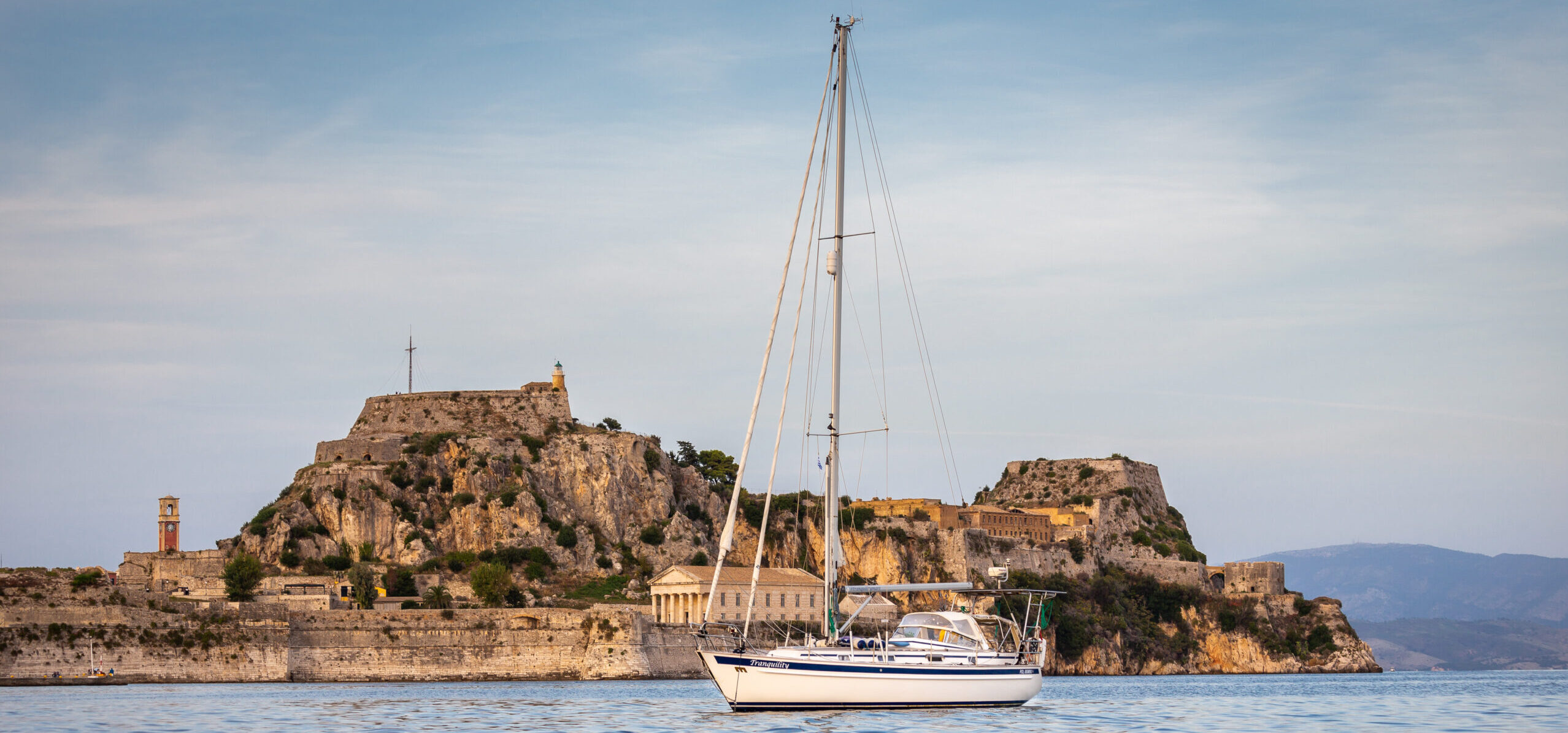

Welcome to the second part of our Caledonian Canal sailing adventure!
This time, we’ll take you along the stretch from Fort Augustus to Inverness – all the way to the canal’s end. We’ll sail across the legendary Loch Ness, keeping an eye out for the monster said to lurk in its depths. There will be another mountain hike, and finally, we’ll finish the passage in Inverness – a town slightly less charming than the rest of the Canal.
If you haven’t yet read the first part of our story, covering the route from Fort William to Fort Augustus, make sure to check it out first. Together, the two parts create a complete guide to the Caledonian Canal – not only from a sailor’s point of view, but also from a traveler’s. The first part also covers general information about the canal, locking techniques, and plenty of other useful tips! Welcome aboard!
Day 5 – Caledonian Canal Sailing
Route: Fort Augustus – Drumnadrochit (Loch Ness)
Distance: 14 NM
Fort Augustus
We start our morning in Fort Augustus with an intense round of locking work. The town is home to a flight of five locks, which in our case — sailing toward Inverness — will take us down. That’s only three fewer than the famous Neptune’s Staircase, so the whole process looks just as impressive.
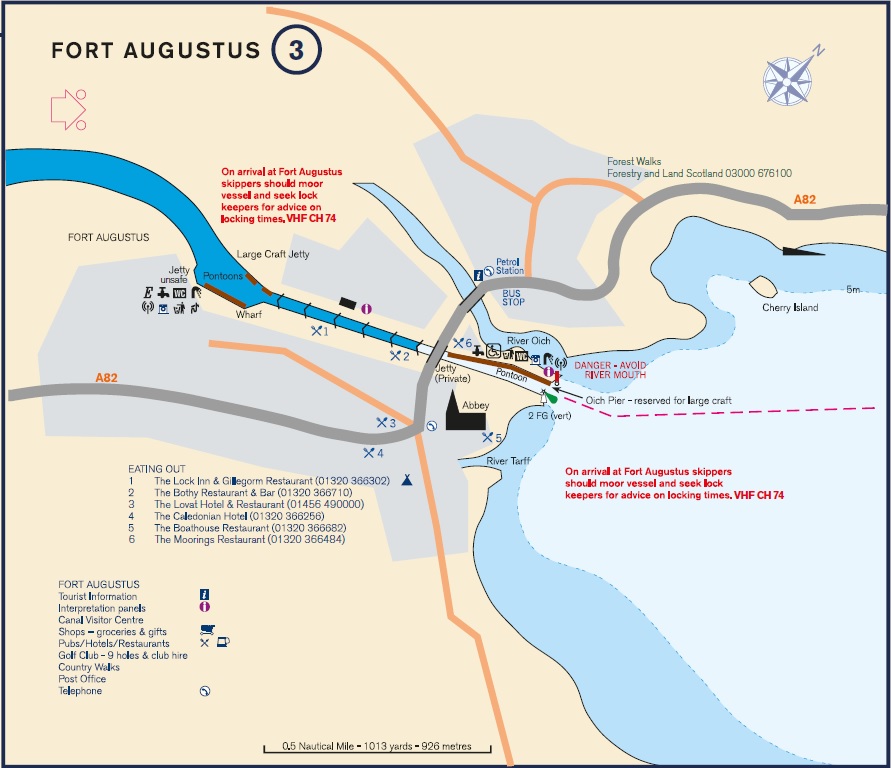
Going downhill makes everything much quicker. The lock chambers can be emptied fast, as the sluices at the base of the gates are opened fully. When locking up, the process must be slower to avoid the strong turbulence caused by the incoming water.
Just like at Neptune’s Staircase, one of us leaves the boat and walks it along the towpath using the bow line. This time, I stay on board while Tomek handles the lines from shore. Soon, the Canal staff joins in, and the whole operation runs smoothly — quick, easy, and in a wonderfully friendly atmosphere.
Sailing the Loch Ness
This is the moment we’ve been waiting for all season — we’re sailing onto Loch Ness! The weather is perfect, the scenery is spectacular (yes, you’ll see that statement more than once in our Scottish posts), and the wind is just right for sailing. We hoist the sails and keep a sharp lookout ahead, wondering if the famous Nessie will rise from the depths. She must be out there somewhere!
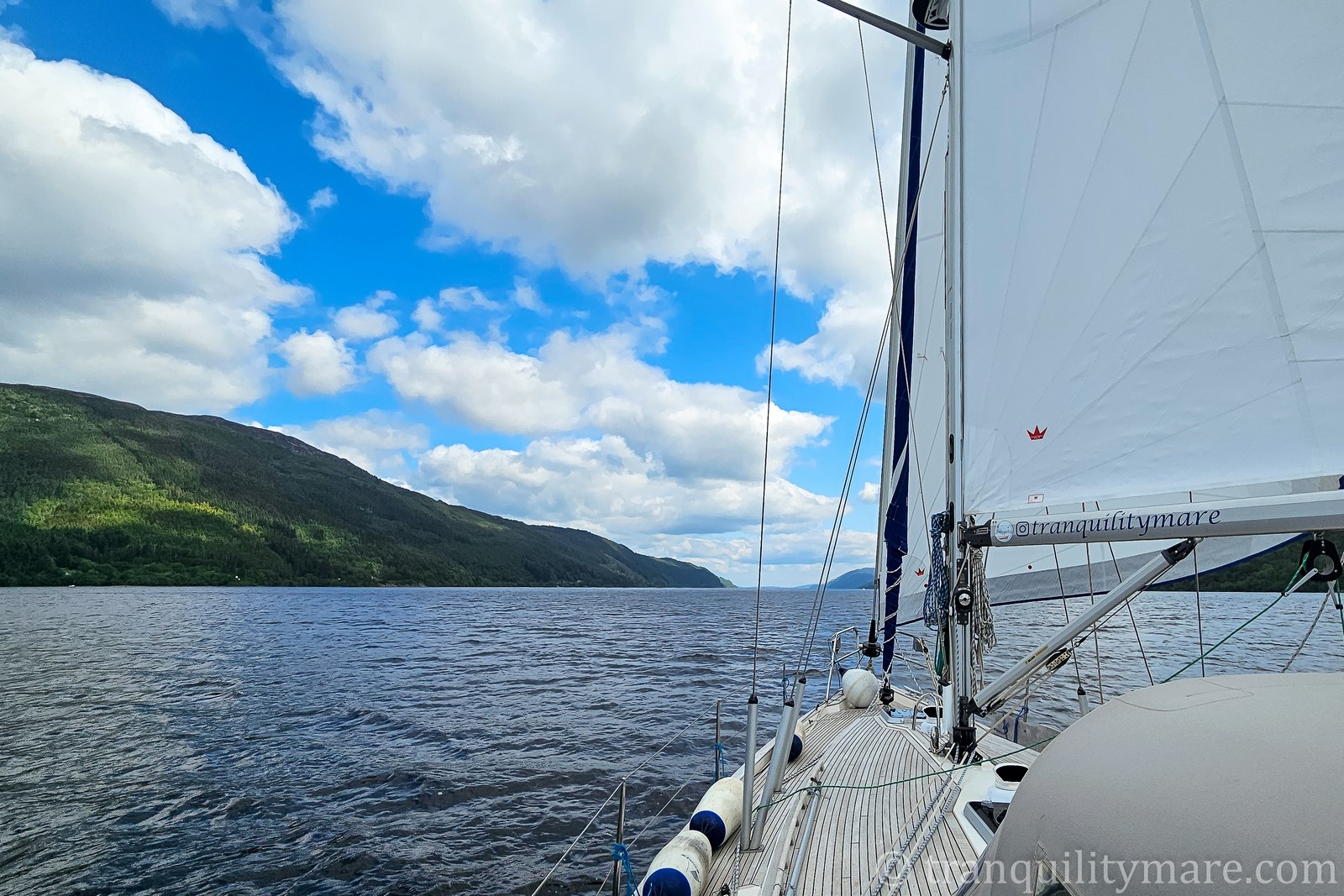
Loch Ness is without doubt the most famous lake in Scotland — and not only because of the monster legend. It’s a vast, majestic body of water whose scale is truly impressive, especially when you realize how deep it goes. The maximum depth reaches 230 meters, making it one of the deepest lakes in the UK.
Stretching for about 37 kilometers, Loch Ness is surprisingly narrow — only around one and a half kilometers wide on average — which makes it feel even deeper. The steep, forested hills plunge almost vertically into the water, creating dramatic, awe-inspiring scenery. This mix of raw power, natural beauty, and mystery makes Loch Ness unlike any other place in Scotland.
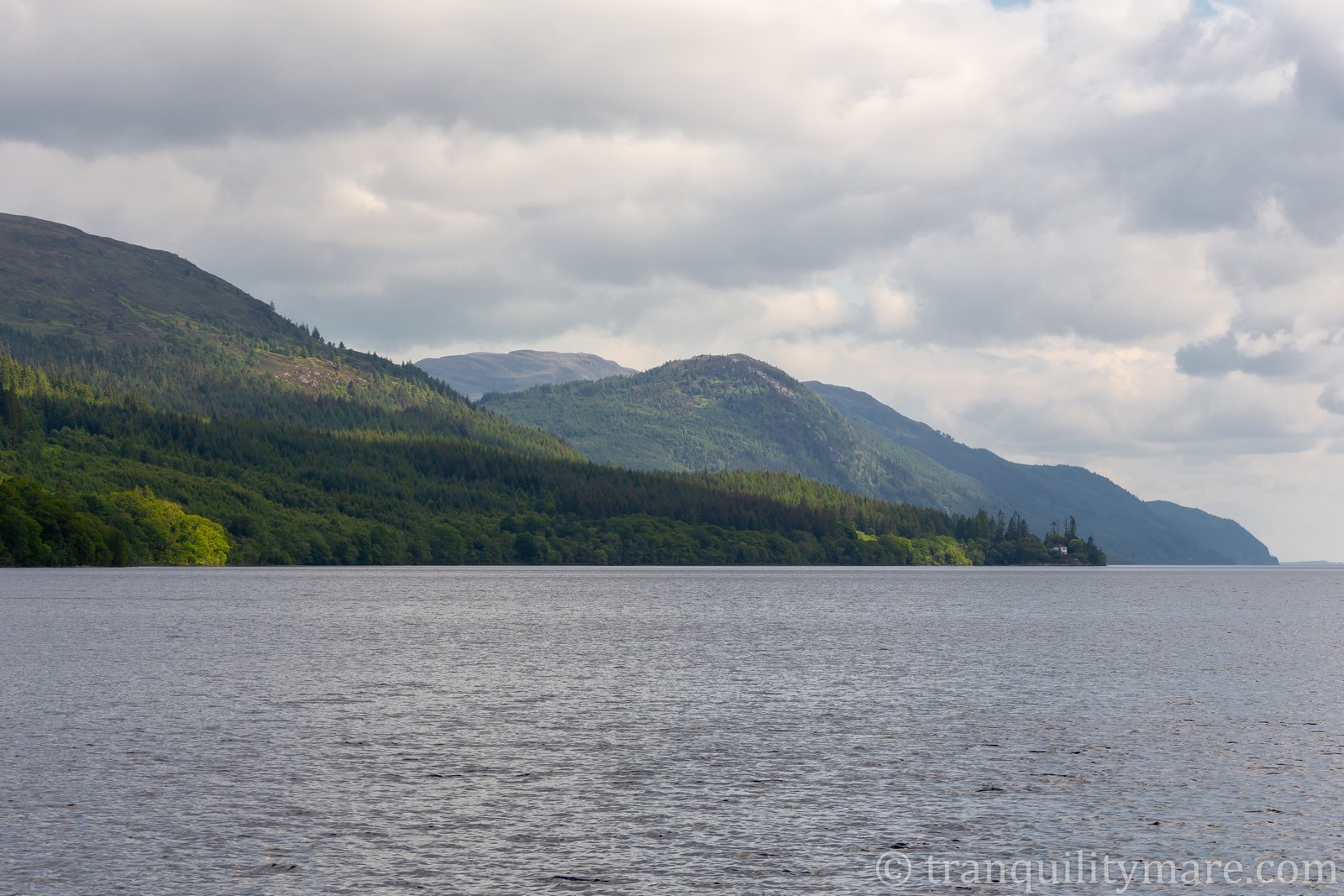
The lakebed drops off sharply just a short distance from shore, and the depth sounder quickly starts showing impressive numbers. This dramatic topography, carved long ago by glaciers, gives Loch Ness the look and feel of a fjord rather than an inland lake. The same feature, however, makes it far from ideal for anchoring — there are few places with enough flat ground for a secure hold.
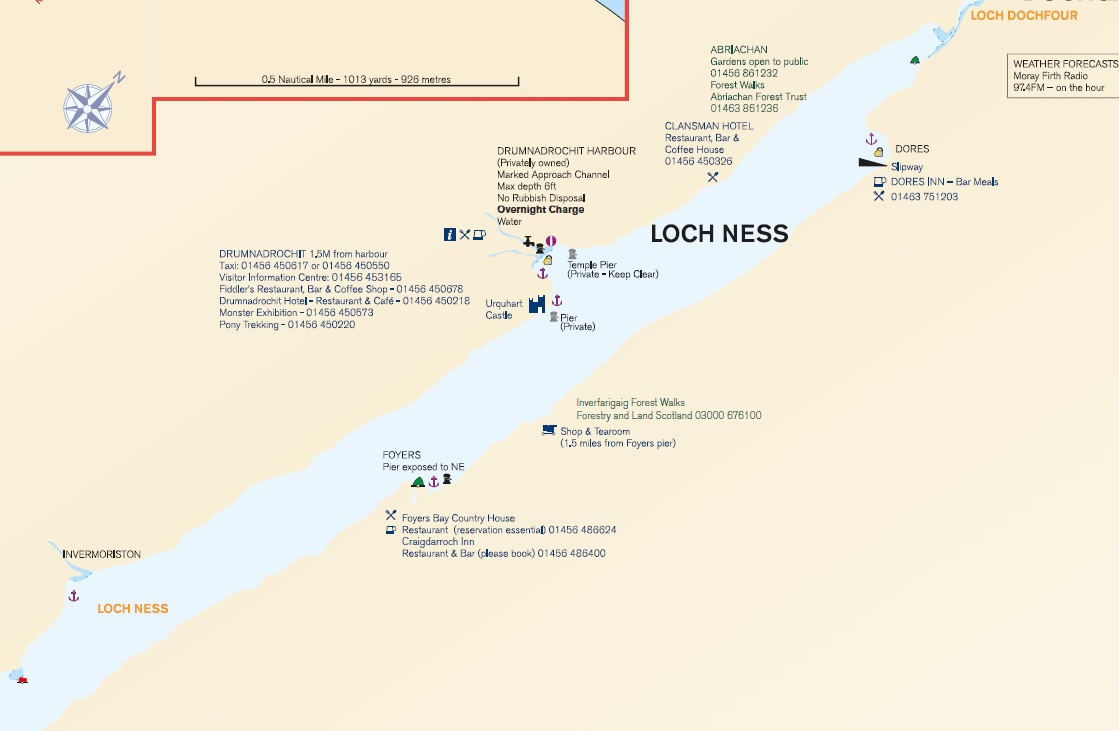
Drumnadrochit Bay and Urquhart Castle
One of the few places suitable for stopping on Loch Ness is Drumnadrochit Bay, where most yachts plan a break in their passage. This is also where you’ll find the famous Urquhart Castle — one of the most iconic landmarks in Scotland. You can admire it from the water or visit it on shore, and the sight of its ruins towering above the lake is truly spectacular.
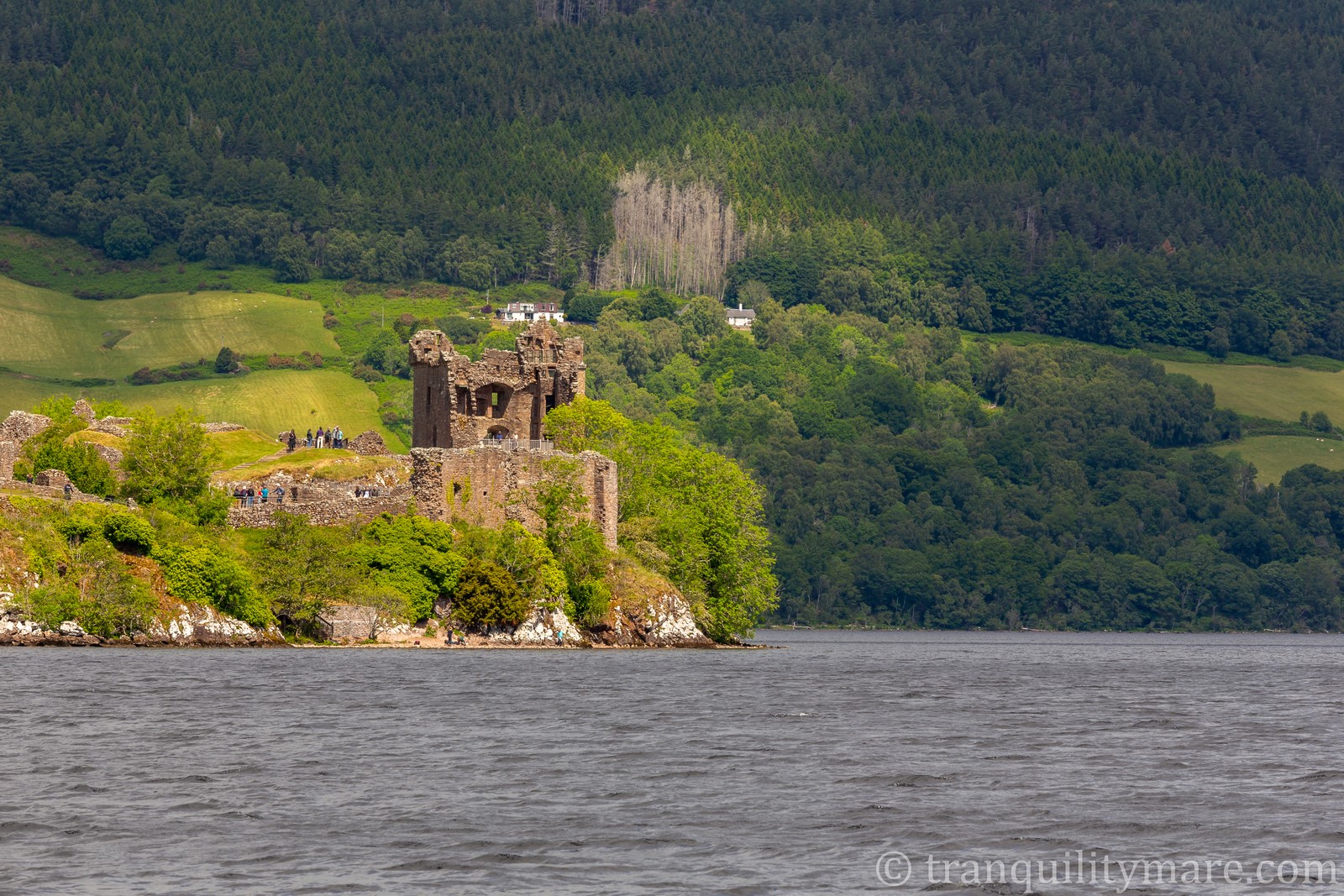
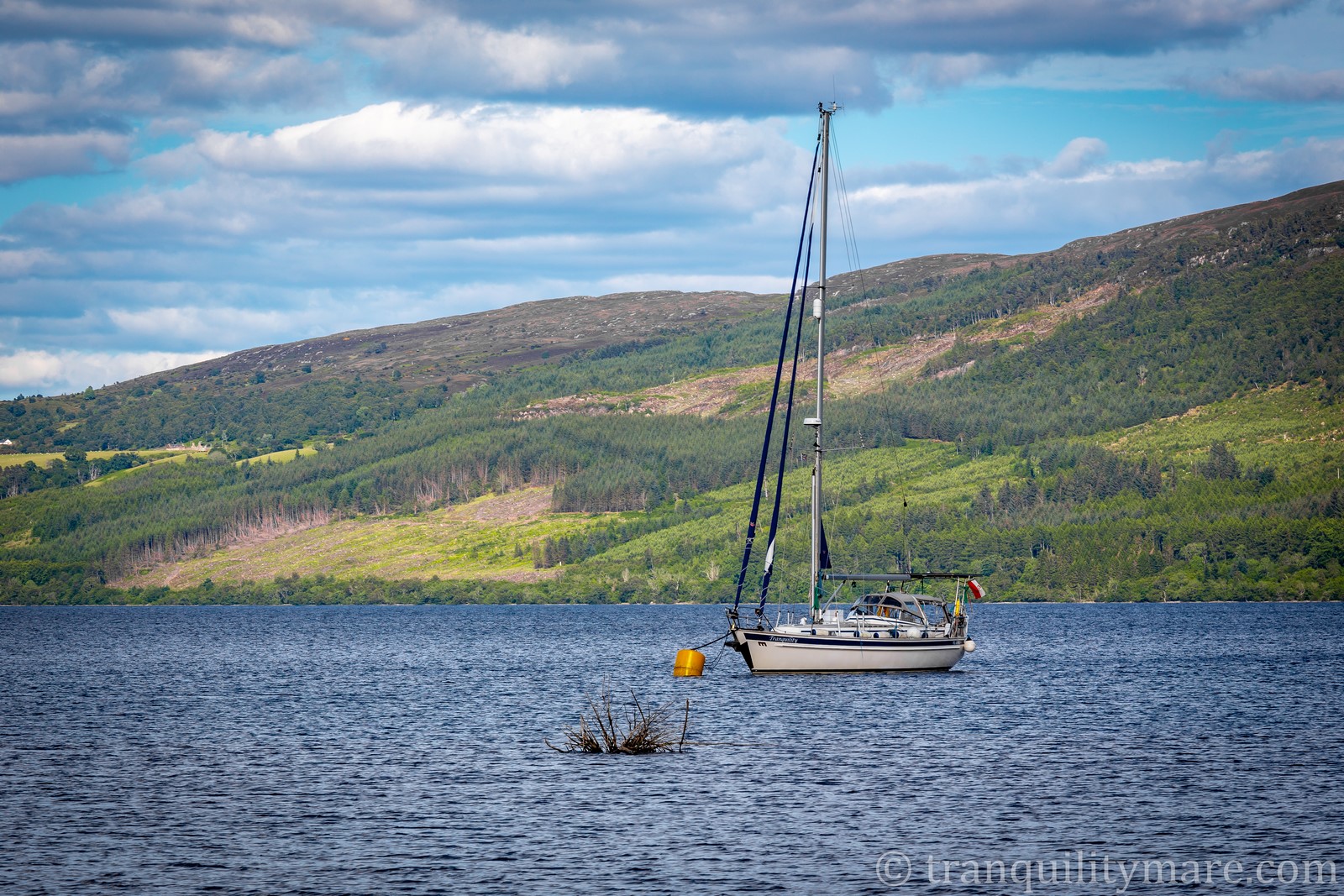
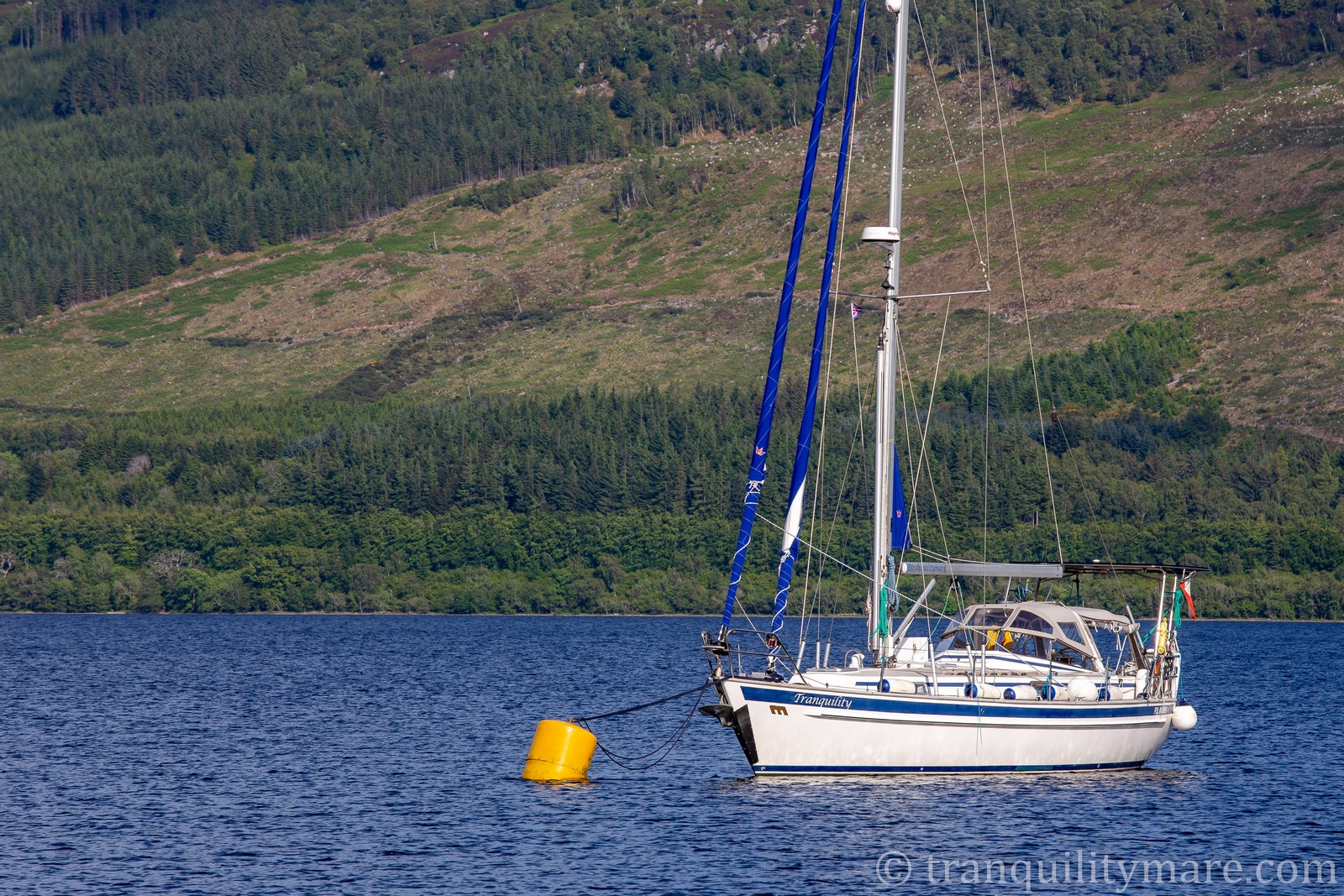
It’s possible to anchor in the bay behind the castle, though finding a patch of reasonably flat bottom is quite a challenge. Alternatively, there’s a single mooring buoy that can be used — if you’re lucky enough to find it free. We were — and we quickly tied up, watching as other yachts arrived, circled around, and eventually had to sail on in search of a spot elsewhere.
On the northern side of the bay, there’s also a small marina, though it’s not one we’d recommend. It has just two berths for smaller yachts, doesn’t have the best reputation among sailors, and the approach channel is shallow — according to the canal guide, the maximum depth is around three meters.
Loch Ness Centre
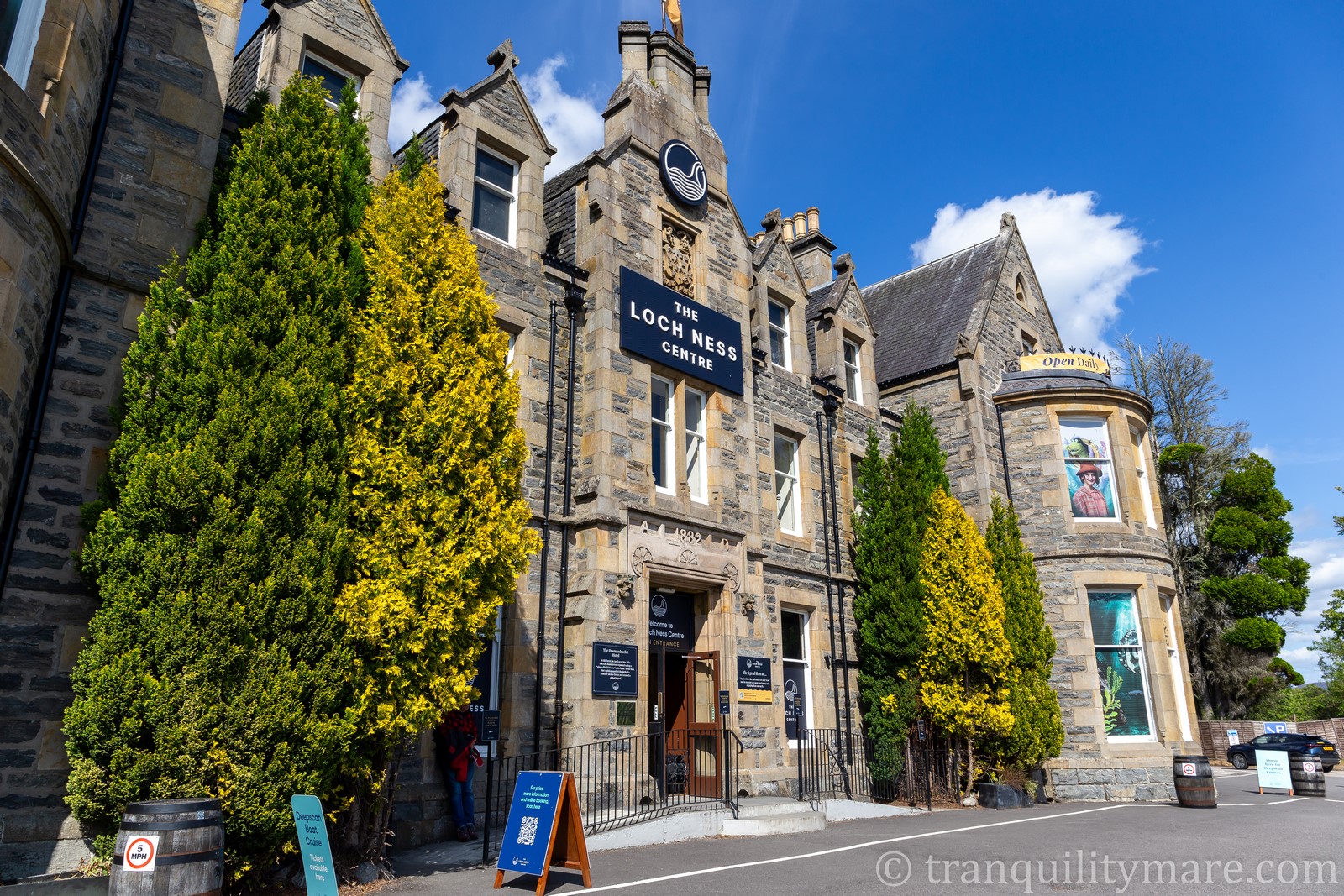
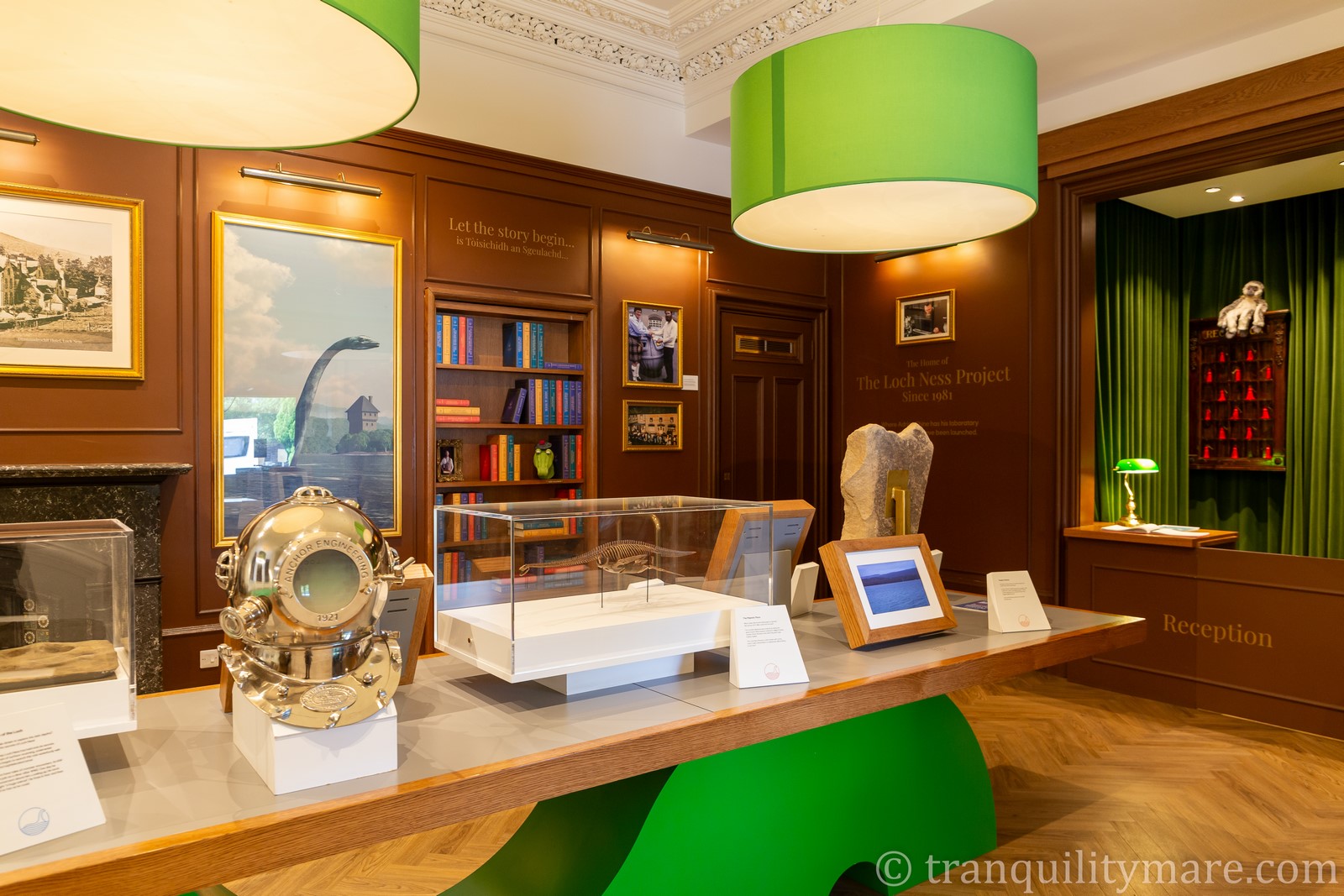
Since Urquhart Castle is mostly ruins — and in our opinion looks much better from the outside than from within — we decided to take a trip to the nearby village of Drumnadrochit to visit the Loch Ness Centre, an interactive museum dedicated to the lake and its famous monster. We left the dinghy at the long pontoon on the western side of the bay — the one by the castle is for visitors only and requires a ticket.
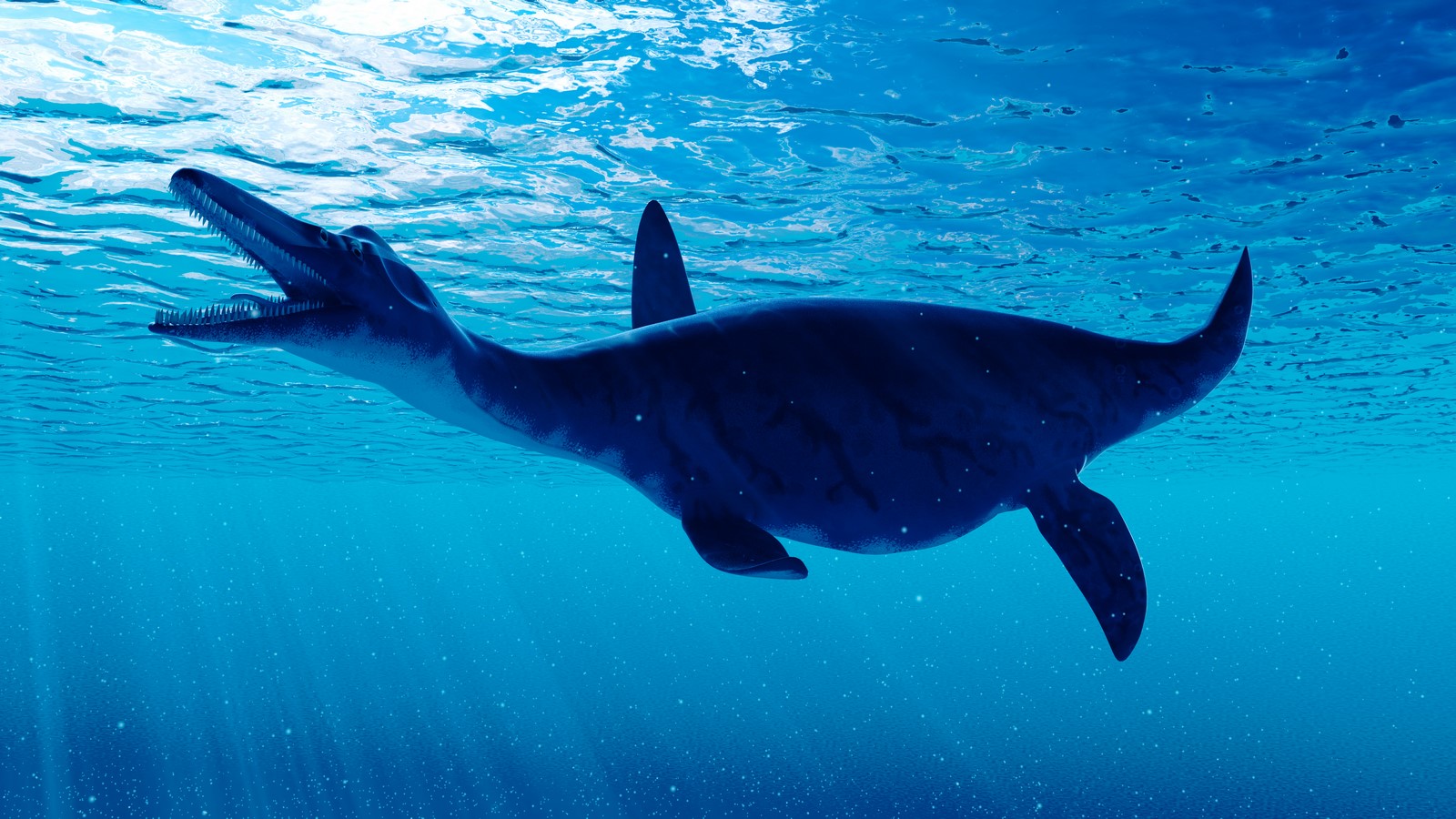
From there, we cut across a few fields to reach the main road and continued on foot toward the village — about three kilometers along a fairly busy route. The museum itself turned out to be quite a disappointment, and to be honest, we wouldn’t recommend it unless you’re traveling with kids. Several rooms show short films about the lake’s topography, the history of Nessie, the various expeditions that searched for her, and theories about what the creature might be — all of it presented in a way that seems aimed at an audience at least two decades younger than us.
Mystery Lost
What I missed most was that special sense of mystery — the kind that should always accompany a story about Loch Ness. Instead of leaving a bit of intrigue, the exhibition simply concludes that the monster doesn’t exist. End of story. Considering the effort it took us to get there, the whole thing felt even more underwhelming. And now what? Who are we supposed to look out for from the deck tomorrow, after being told it was all just a myth?
I hope you can sense the humor in that remark. Of course, I know — and always knew — there’s no real monster in Loch Ness 🙂 Still, there’s something truly unique about this place: that lingering air of mystery, legend, and the unknown. Even when you know Nessie is only a story, you can’t help scanning the horizon — a little out of curiosity, a little out of sentiment. Sadly, the museum took some of that magic away.
We spent the rest of the day back on board, soaking in the sunshine, the views, and the quiet satisfaction of having reached one of our dream destinations for the 2025 season.
Day 6 – Caledonian Canal Sailing
Route: Drumnadrochit – Inverness (Seaport Marina)
Distance: 12 NM
Leaving Loch Ness
Our sixth day marks the end of our sailing through the Caledonian Canal, although technically we’ll remain within its structures for a few more days. The weather isn’t quite as perfect as yesterday, but we’re happy it’s not raining and that we can still enjoy the sail across the final stretch of Loch Ness.
Inverness
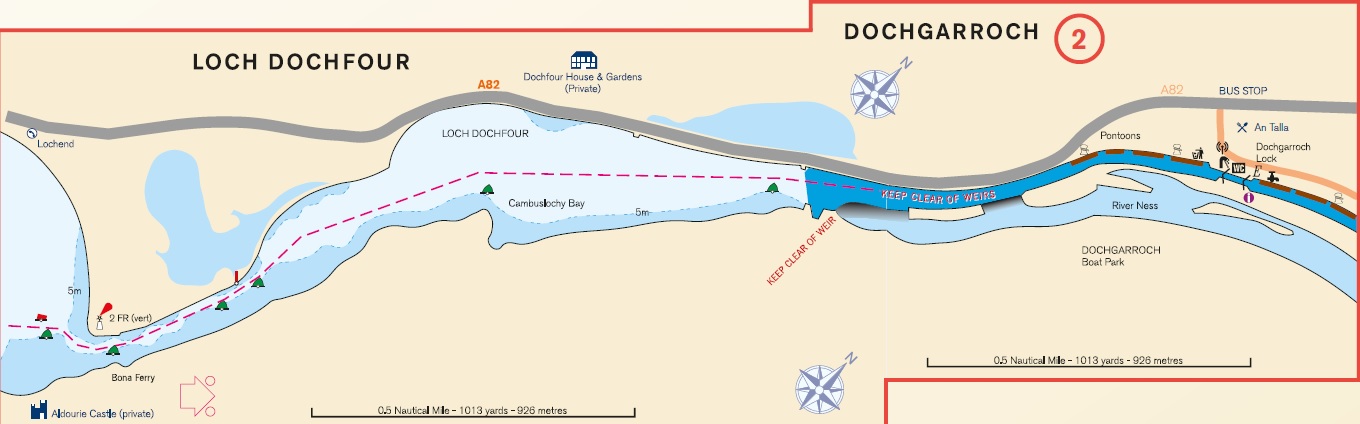
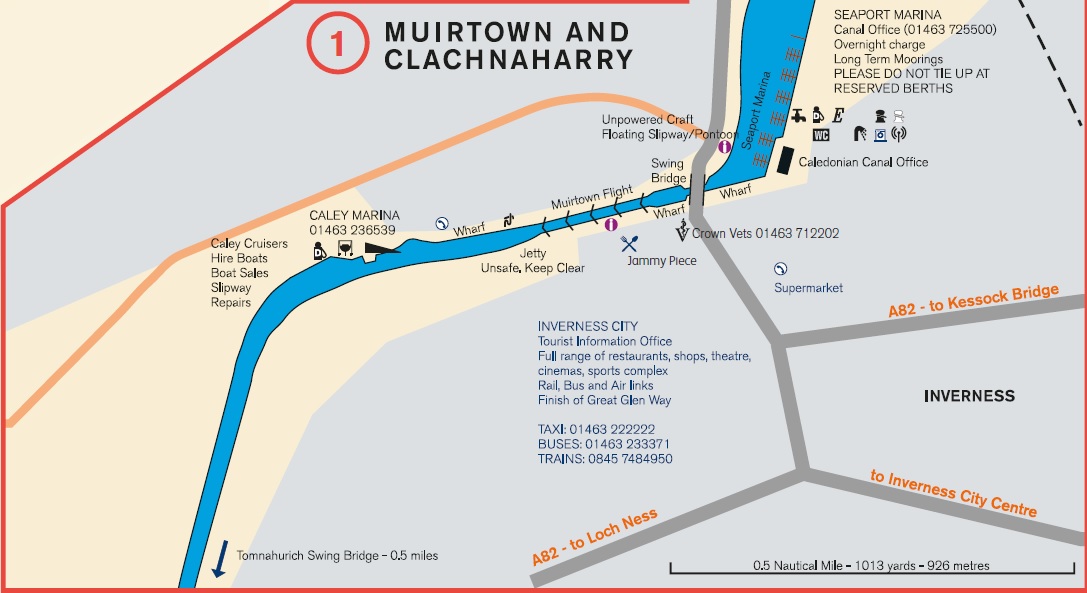
After Loch Ness, there’s one more small and narrow lake ahead — Loch Dochfour — which we pass almost without noticing before reaching the Dochgarroch Lock. Here, we leave the chain of natural lochs behind and re-enter the man-made section of the canal, leading all the way to Inverness and its final four locks.
This is where the unique magic of the Caledonian Canal slowly fades. The closer we get to Inverness, the more the wild Scottish scenery gives way to suburban and slightly industrial surroundings. We stop at Seaport Marina, which, to be fair, is quite a pleasant spot — especially considering that we’re already in Inverness, a place that’s not exactly easy to describe with the same word.
Day 7 – Caledonian Canal Sailing
Trip to the Cairngorm Mountains
Since Inverness didn’t really charm us — and finding ourselves back in an urban environment after so long in nature came as a bit of a shock — we decided to head straight back to where we feel best: the mountains.
Our extended canal license made that possible. Instead of the standard 7-day pass, we had purchased a 14-day one, which allowed us to transit two canals — the Crinan and the Caledonian (we wrote about that in detail here). In practice, this gave us one extra day on the canal — a day we could use for an extra trip. We were also still waiting for a good weather window to sail north to the Shetland Islands, which didn’t seem likely anytime soon, so there was no need to rush. (It’s worth noting that the standard 7-day license can also be extended by up to three days, for an additional fee per day – you can check it here).
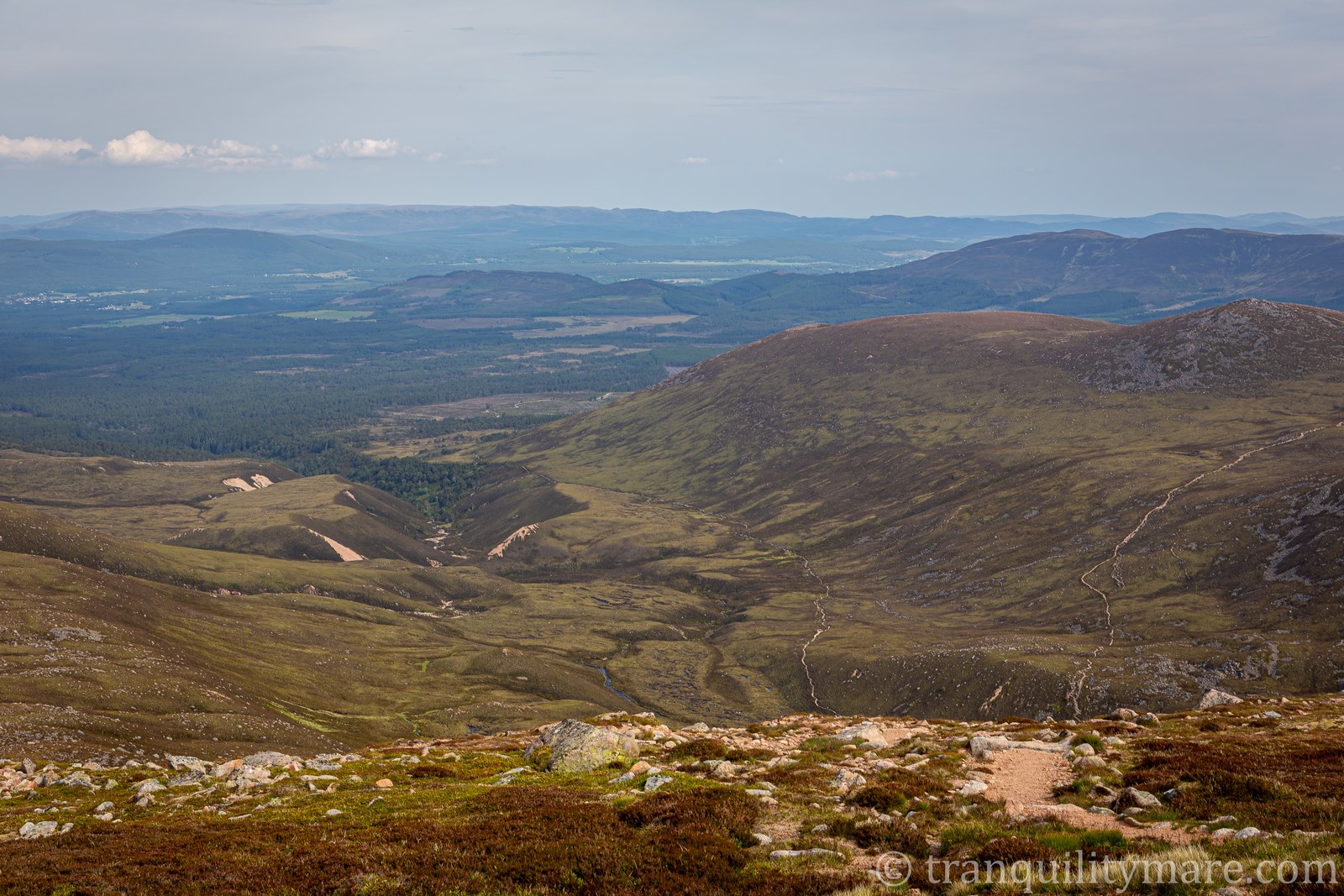
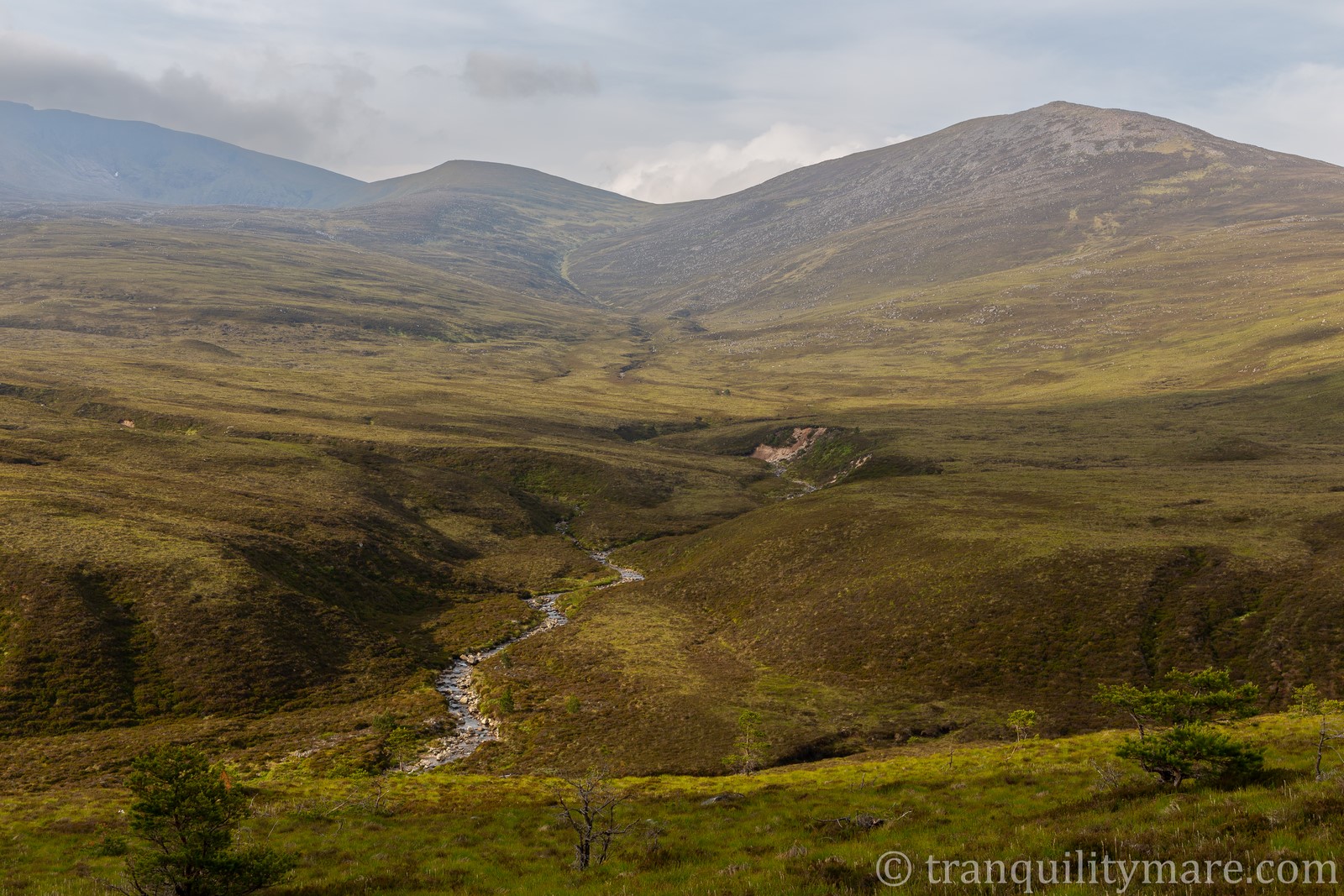
The mountain trip we planned from Inverness wasn’t the easiest one logistically, and it’s definitely not a typical attraction for sailors passing through the Caledonian Canal. It’s more of an idea for those with a bit of extra time — and a real love for the mountains. About 40 kilometers south of Inverness stretches the impressive Cairngorm range, one of the most beautiful and rugged regions in all of Scotland.
Cairngorm National Park
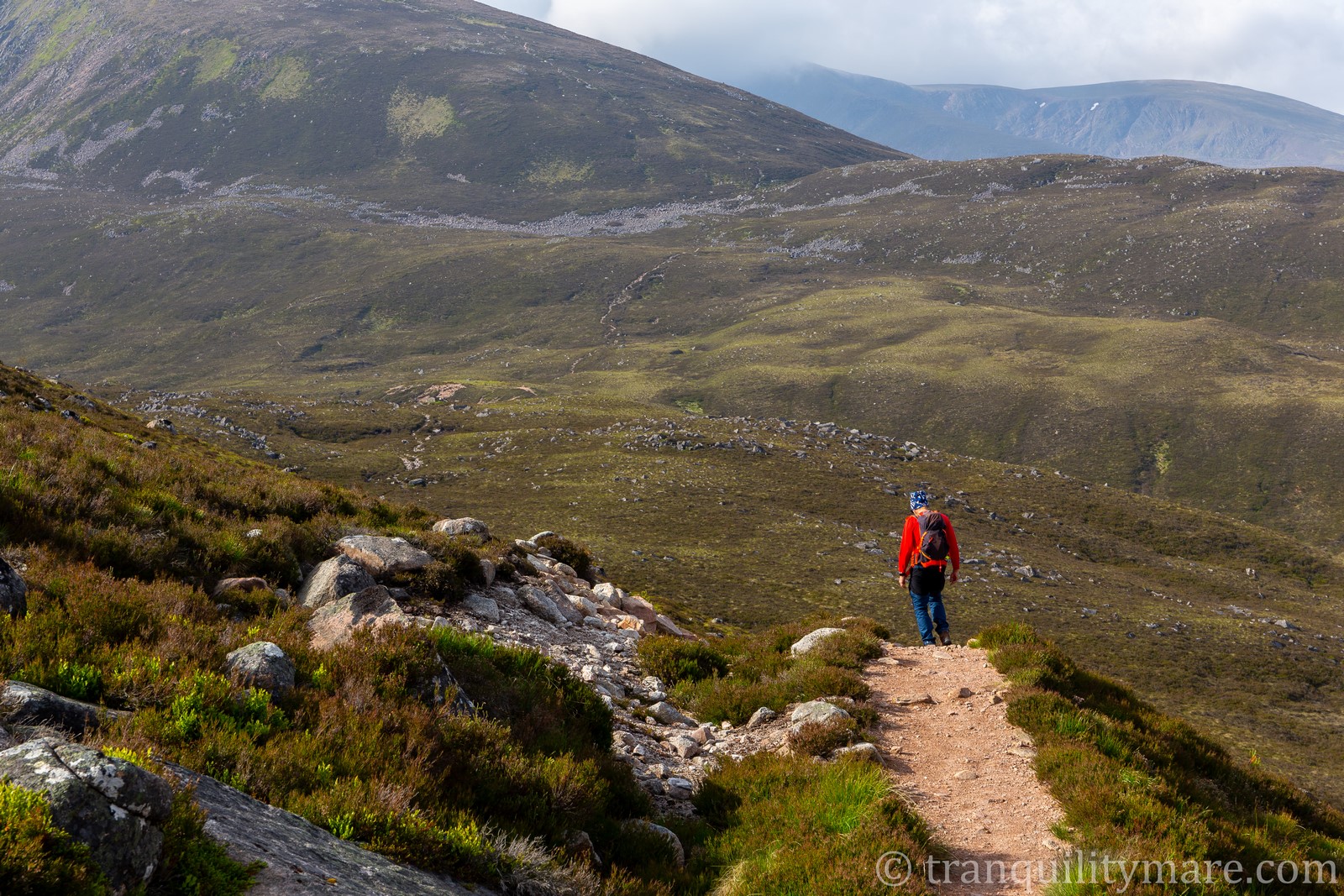
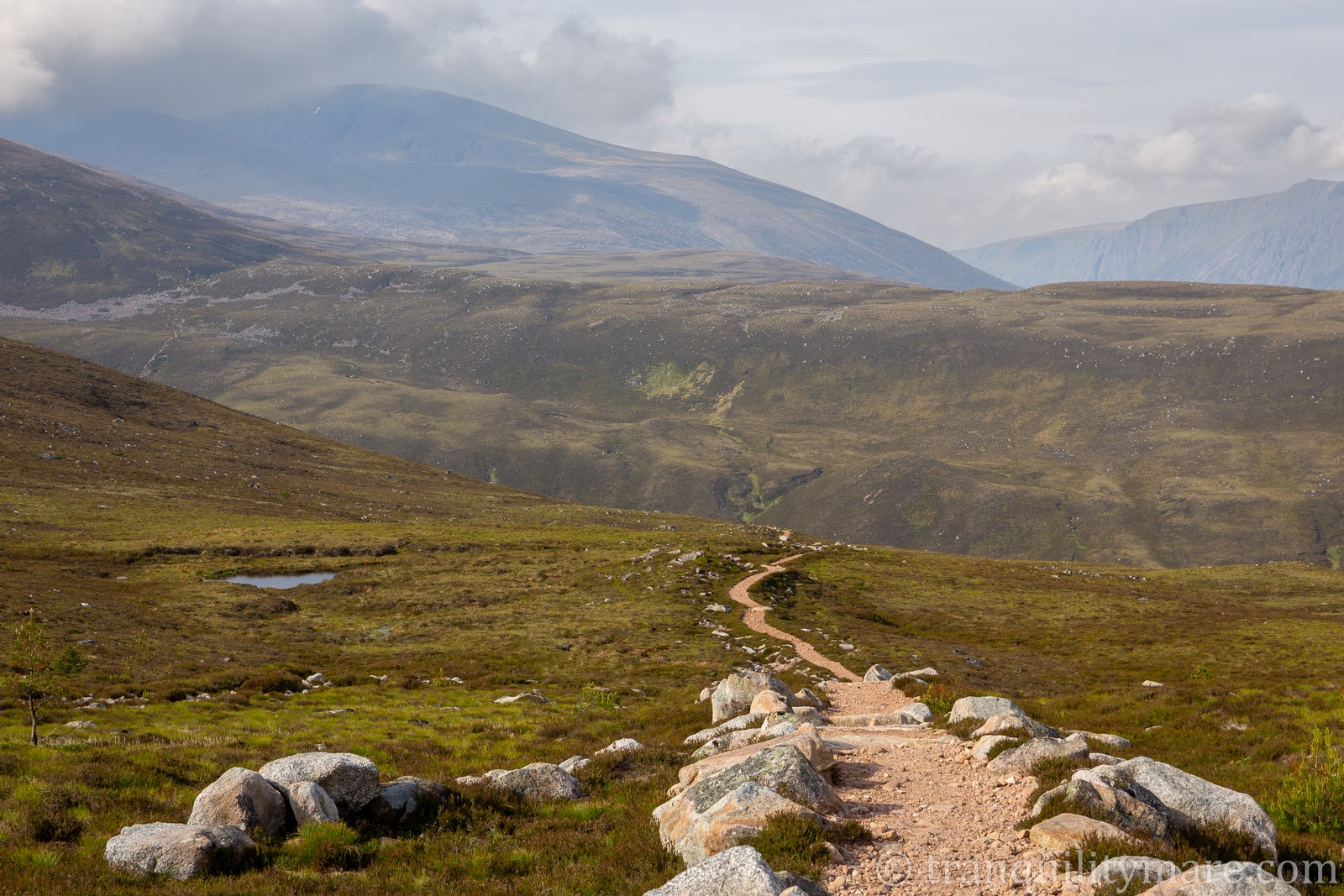
From Inverness, we took a bus to Aviemore, a perfect base for both short hikes and longer treks into the heart of the Cairngorms National Park. From there, we caught a local bus (line 30) to the Cairngorm Mountain Resort, where we began our hike to the summit of Braeriach (1,296 m) — the third-highest peak in the UK.
The route was spectacular: breathtaking views, wild landscapes, silence, and nature so raw it makes you forget everything else. By late afternoon, with nearly 30 kilometers behind us, we descended back to Aviemore — tired, but absolutely thrilled. Both the village and the ski resort above it are excellent starting points for countless trails across the Cairngorms, ranging from short scenic walks to ambitious full-day adventures in the high mountains.
Day 8 – Caledonian Canal Sailing
Route: Inverness (Seaport Marina) – Inverness Marina
Distance: 2 NM
The next day it was time to say goodbye to the Caledonian Canal. Two final locks awaited us — including the sea lock that would open the way to the North Sea. We coordinated our departure from Seaport Marina on channel 74 to match the planned opening of the lock, then the railway bridge, and finally the last sea lock.
After 29 locks on the Caledonian Canal and 15 more on the Crinan, locking through has become second nature to us. Every maneuver feels smooth and instinctive, as if we’d been doing it our whole lives. We leave the canal and head out to sea… though only symbolically. There’s still no proper weather window for our passage to the Shetland Islands, so we make our way to the next marina — Inverness Marina, located just beyond the canal’s end.
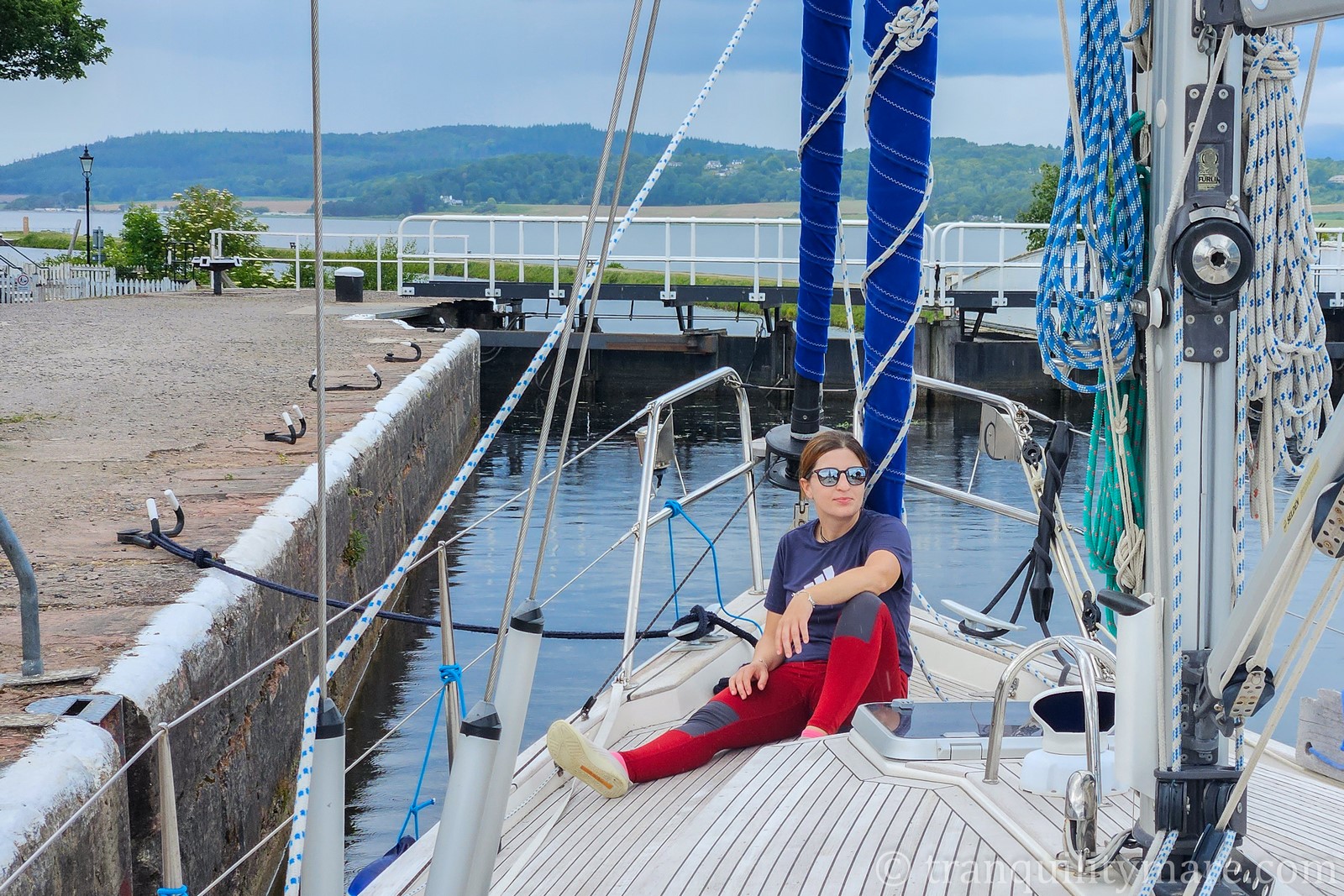
It’s a well-considered move — not only because our canal license is about to expire, but also to give ourselves full freedom to set sail whenever the conditions are right, without having to wait for the locks to open again.
Summary – Caledonian Canal Sailing
Even though I often joke that we’re an ocean-going yacht, not a river barge, I consider our passage through the Caledonian (and Crinan) Canal to be one of the absolute highlights of our 2025 season.
The Caledonian Canal, with its scale and popularity, turned out to be much calmer and more flexible from than the Crinan Canal. The locks are larger, the maneuvers much simpler, and we had far more freedom in choosing where to stop and how to plan our route exactly the way we wanted.
The spectacular mountains surrounding us, the glacial lakes, mostly favorable weather and winds, and the incredible, untamed nature — all of it completely captivated us.
I truly believe that every sailor planning to cruise in Scotland should experience this canal at least once. If not the entire route, then at least its most picturesque stretch — from Fort William to Loch Ness and back.
This “day-by-day” plan above worked perfectly for us. Feel free to use it and adapt it to your own needs. And if you ever need help or advice about sailing through the Caledonian Canal — don’t hesitate to get in touch!



No responses yet